Beethoven, van Ludwig - Twelve Variations on "See the conqu'ring hero comes" from Handel's Judas Maccabaeus, WoO 45 - Cello and Piano - Edited by Morganstern - International Music Co.
Beethoven, van Ludwig - Twelve Variations on "See the conqu'ring hero comes" from Handel's Judas Maccabaeus, WoO 45 - Cello and Piano - Edited by Morganstern - International Music Co.
Ludwig van Beethoven considered George Frideric Handel the greatest composer that ever lived; the “unequaled Master of all Masters.” Beethoven admired Mozart and Bach, but he admired Handel even more. He told his student, the Archduke Rudolph that the works of Handel “always offer the greatest nourishment.” Frederick William II, the cello-playing King of Prussia, also loved the music of Handel. We know that because he sponsored a massive performance of The Messiah in the Berlin Cathedral (it could very well have been Mozart’s re-orchestrated 1789 German language version). It is very likely that Beethoven wrote these variations on “See the conqu’ring hero comes” from Handel’s oratorio Judas Maccabaeus with the King’s devotion to Handel in mind.
In February of 1796 the twenty-six-year-old Beethoven left Vienna for a concert tour that included PRague, Dresden, Leipzig and Berlin. He knew Friedrich Heinrich Himmel, who was the Kapellmeister in Fredrick William’s Berlin court, so when Beethoven’s first two cello sonatas (published as Opus 5) and his new set of variations were first performed there in May of 1796, Himmel could have played the piano. The cello parts were certainly played by either Jean-Pierre Duport (Fredrick William’s teacher and the first cellist in his court orchestra) or Jean-Pierre’s younger brother Jean-Louis, who was considered to be an even better cellist.
The Twelve Variations were published by Antara in 1797. I would like to dedicate this edition to Liny Clarke.
-Daniel Morganstern, April 2021
This edition contains the solo part and the accompanying piano part. The cello part and the piano part were edited by Daniel Morganstern.
Original: $21.75
-70%$21.75
$6.52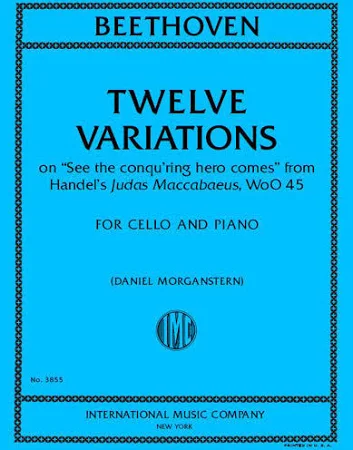
Description
Ludwig van Beethoven considered George Frideric Handel the greatest composer that ever lived; the “unequaled Master of all Masters.” Beethoven admired Mozart and Bach, but he admired Handel even more. He told his student, the Archduke Rudolph that the works of Handel “always offer the greatest nourishment.” Frederick William II, the cello-playing King of Prussia, also loved the music of Handel. We know that because he sponsored a massive performance of The Messiah in the Berlin Cathedral (it could very well have been Mozart’s re-orchestrated 1789 German language version). It is very likely that Beethoven wrote these variations on “See the conqu’ring hero comes” from Handel’s oratorio Judas Maccabaeus with the King’s devotion to Handel in mind.
In February of 1796 the twenty-six-year-old Beethoven left Vienna for a concert tour that included PRague, Dresden, Leipzig and Berlin. He knew Friedrich Heinrich Himmel, who was the Kapellmeister in Fredrick William’s Berlin court, so when Beethoven’s first two cello sonatas (published as Opus 5) and his new set of variations were first performed there in May of 1796, Himmel could have played the piano. The cello parts were certainly played by either Jean-Pierre Duport (Fredrick William’s teacher and the first cellist in his court orchestra) or Jean-Pierre’s younger brother Jean-Louis, who was considered to be an even better cellist.
The Twelve Variations were published by Antara in 1797. I would like to dedicate this edition to Liny Clarke.
-Daniel Morganstern, April 2021
This edition contains the solo part and the accompanying piano part. The cello part and the piano part were edited by Daniel Morganstern.